
Incomplete, withdraw, or pay someone: the arithmetic on a graduate transcript
Four ways out of a course that is going wrong, and a way to price each one before you pick. For a lot of graduate students the right answer is an Incomplete or a planned withdrawal — and those are the two nobody sells you.
Most advice about a course going wrong is written for an eighteen-year-old taking five of them. The arithmetic is different when the course costs several hundred dollars a credit, when an employer is paying under an agreement you signed once and have not read since, and when the course sits in a sequence that only runs at certain times of year. This post is about that version of the decision: four paths, what each one actually costs, and which questions have published answers rather than opinions.
Why the decision looks different at graduate level
A graduate course is not an undergraduate one with harder reading. It is expensive per credit, it is frequently employer-funded, and it is often one link in a chain — a prerequisite for the spring course, which is a prerequisite for the practicum, which may be scheduled once a year. So the cost of a bad week-six decision is rarely the one course. It is what the decision does to the next three terms.
There are four paths and this post prices all of them: an Incomplete, a withdrawal, a retake after a failing grade, and paying someone to carry the work. Worth saying at the top, because it is true often enough to matter: the first two are frequently the right answer. Most people searching pay someone to do my class in week six have not yet priced the alternatives, and that arithmetic usually makes the decision obvious in one direction or the other.
The formula, in your own numbers
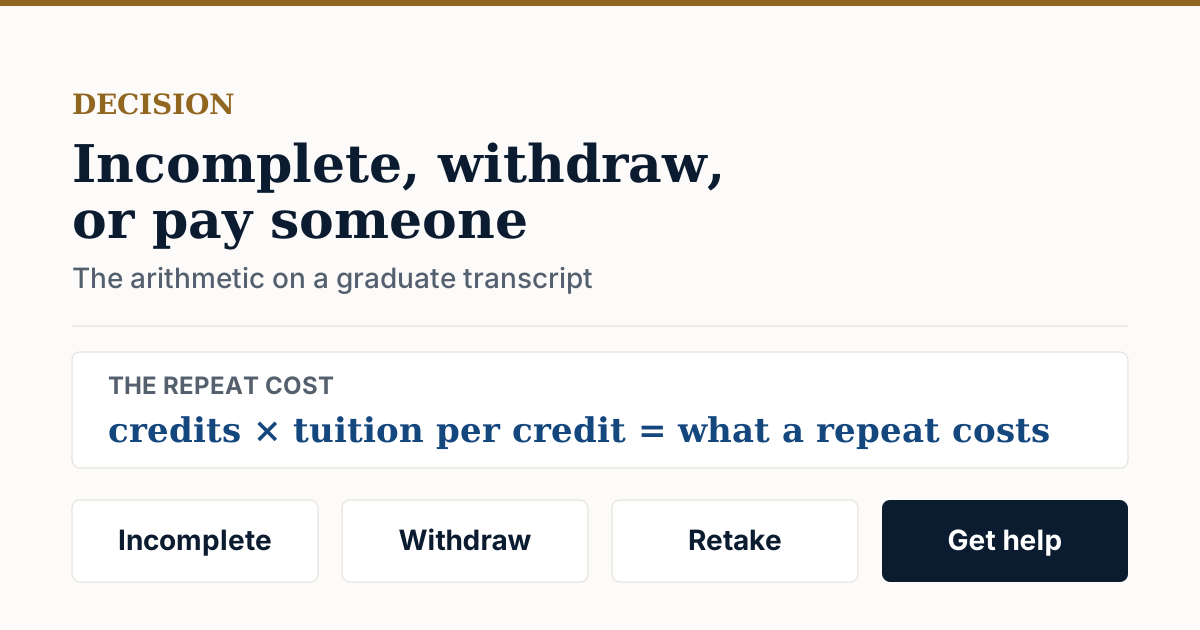
Four lines, filled in from your own student account rather than from an article. One: credits × tuition per credit = what repeating this course costs. That figure anchors everything else. Two: add any delay. If the course gates the next one, a term lost is a term of fees, and sometimes a year when the sequence runs annually. Three: add anything you may owe back. Employer tuition agreements commonly tie reimbursement to completing the course or reaching a minimum grade, and whether a withdrawal counts as a non-completion is in your agreement, not in any general rule. Four: add any effect on aid. Enrolment levels and satisfactory-progress rules are set by your institution and your funder, and dropping below a threshold mid-term can cost more than the course does.
An illustration with made-up round numbers — use your own. A three-credit course at $600 a credit is $1,800 to repeat. If it gates a course that runs only in the spring, add two terms to the degree. If the employer agreement asks for a B or better, add whatever that clause says you return. The point is not the $1,800, which is invented. It is that every one of those figures is knowable in about ten minutes from the registrar's page and your own paperwork, and that almost nobody looks them up before choosing.
The Incomplete
An Incomplete is an agreement, not a right. It generally needs the instructor to agree, generally needs a reason with a shape to it — illness, a deployment, a bereavement, a work crisis that had an end date — and it comes with a deadline for the outstanding work. Miss that deadline and at many institutions the I converts to a failing grade on its own, which leaves you worse off than where you started.
It fits one kind of problem well: a bounded disruption. Six weeks of a fourteen-week course went wrong for a reason that has now stopped, you can do the work, you simply could not do it then. Where that is an honest description of your term, take the Incomplete. It costs nothing, it keeps the tuition you have already paid, and the course stays yours.
Where it fits badly is a term that was overcommitted from the start, because an Incomplete carries this term's work into the next one on top of next term's work. Programmes differ on how many you may hold and on how they read a second one, and that is in the handbook rather than in anyone's advice.
The withdrawal
A withdrawal usually produces a W, which generally carries no grade point. That is its whole appeal, and the appeal is real. What it does not do is make the course go away: you still have to take it, and tuition is often non-refundable past a date the registrar publishes at the start of term. Find that date before anything else on this page.
Then check four things, because all four are programme and institution rules rather than general ones. Whether a W counts toward a progression or satisfactory-progress review — many programmes open a review after a single failed course, and whether a withdrawal is treated the same way varies. Whether dropping the course moves you below a full-time or half-time enrolment threshold your aid depends on. Whether the course is a prerequisite that runs in only one term of the year. And whether your employer's agreement reads a withdrawal as a non-completion.
If you have not yet worked out what is still mathematically winnable with the points left in the course, do that first, because it often decides this section for you. Our guide to a class you are failing has that weighted calculation and the email to send your instructor.
The retake, and the F
If the course ends in a failing grade, the cost is the formula again plus whatever the sequence costs in time. Two institutional rules decide how heavy that is, and both are published rather than negotiable.
The first is grade replacement. Some institutions replace the original grade in the GPA when a course is repeated; others keep both attempts on the transcript and in the calculation. That one difference changes what a retake is worth before you have done anything.
The second is the minimum-grade rule. Many graduate programmes require a B or better in core courses, which makes a C a different kind of event here than it would be in an undergraduate degree — not a weak result to be averaged away, but a course that may have to be taken again regardless of the GPA. If your programme has that rule, the distance between passing and passing well enough is the distance that matters. Your registrar's page and your handbook each answer this in a paragraph.
Paying someone — what it costs and what it does not fix
Our own path, priced the same way as the others. We complete coursework on behalf of the people who hire us. Whole-course support starts from $49 a week and a single assignment from $30, quoted as one fixed all-in figure agreed before any work begins, and the assessment that produces that figure is free — a person replies within about two hours. If you want to see the structure behind it, pay someone to take my class is the page that sets it out.
Now the limits, which matter more than the price. It does not change what your institution does if it objects to the work; those consequences are the student's, which is our published position on the academic integrity page and the whole subject of the companion piece on what actually happens if you are caught. It does not substitute for practicum hours, clinical placements or anything that needs you physically present. And it does not fix a course whose real problem is time you will not have next term either, because that problem follows you into the retake.
So, plainly: if an Incomplete or a planned withdrawal solves the problem you actually have, take it. When someone asks us to take my online class for me and the better answer is their registrar, we say so, because the alternative is selling something that was never going to work.
Before you choose: five things to check
None of this takes an afternoon and all of it is free. One: your registrar's withdrawal and refund deadlines for this term, which are dates rather than judgement calls. Two: your programme's progression rule — the minimum grade in core courses, and what opens a review. Three: your enrolment and aid status, and what dropping a course does to both. Four: your tuition reimbursement agreement, if an employer is paying, and specifically what it treats as a non-completion. Five: whether what you need first is a conversation with your instructor or your chair, which costs nothing and is where an Incomplete comes from in the first place.
Work through those five and the decision usually makes itself. If it makes itself in our direction and you want a figure, take my class for me is where that starts: the assessment is free and comes before any payment, and it sometimes ends with us saying no.
This article is educational content and is not financial, legal or academic advice. Deadlines, grade rules, progression standards and aid thresholds vary by institution and by programme, and reimbursement terms vary by employer. Check your own registrar, programme handbook, financial aid office and tuition reimbursement agreement before deciding anything.