
You're failing an online class. Here's exactly what to do next.
If you're reading this at 2am with a knot in your stomach, start here. Failing a course feels like a cliff edge, but it's almost always more recoverable than it looks from where you're standing. This is a calm, concrete plan — no judgement, no panic — for the next few steps, whether you fix it yourself or ask for help.
First, the thing nobody says clearly enough: falling behind in an online class is not a verdict on your intelligence or your worth. It is, overwhelmingly, a scheduling failure — the predictable result of a format that demands constant small efforts colliding with a life that had no slack to give. Working adults, parents, people juggling accelerated programs and full-time jobs: this happens to capable people constantly, and it happens quietly, because online courses don't have a professor who notices you've gone missing. So set the shame aside. It's not helping, and you have decisions to make that are better made calmly.
What follows is a step-by-step triage plan. Much of it you can do yourself, today, for free — and we'd genuinely rather you did if that's what fixes it. The last step covers when getting help makes sense, and how to do that without getting scammed. Work through it in order. By the time people write take my class for me, they have usually already spent a week deciding whether to ask.
Step 1 — Find out where you actually stand
Panic thrives on vagueness. The single most calming thing you can do right now is replace "I'm failing" with an exact number. Open your gradebook and your syllabus side by side and work out three things: your current grade, how much of the total grade has already been decided, and how much is still to come. A course that's 40% graded and sitting at a low mark is a very different situation from one that's 90% graded — in the first, the math is still firmly on your side. Use a final grade calculator to see precisely what you'd need to score on the remaining work to reach a passing grade, or the grade you actually want. Very often that number is far more achievable than the dread suggested.
Step 2 — Stop the bleeding
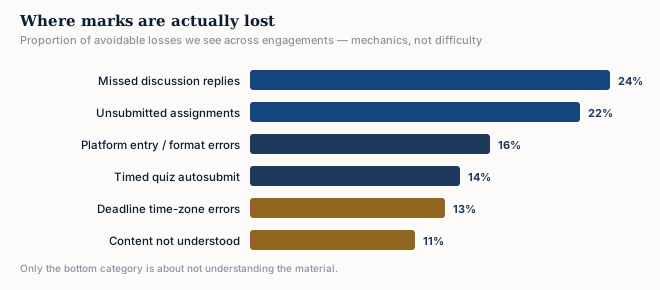
Before you try to claw back what's lost, make sure you're not still losing ground. Identify anything with an imminent deadline — a discussion post due tonight, a quiz window closing, a homework set about to lock — and secure those first. In most online courses, the steady drip of small recurring items (discussions, weekly quizzes, homework) is doing more quiet damage than any single big miss, so plugging that leak is the highest-value first move. It also changes your momentum: instead of watching the hole get deeper, you start the recovery from a stable floor.
Step 3 — Talk to your instructor
This is the step students skip most and regret most. Instructors have more discretion than you'd think, and many will extend a deadline, reopen an assignment, or offer a path to make up work — but almost never for a student who vanished and reappeared with excuses at the end. Email early, be brief and honest, and ask specifically: is there any flexibility on the upcoming deadlines, and is there anything I can do to recover points already lost? The worst outcome is that they say no, which leaves you exactly where you are now. The best outcome can quietly rescue the whole course. Send that email before you do anything drastic.
Step 4 — Decide: recover, withdraw, or get help
With a clear number, the bleeding stopped, and your instructor's flexibility known, you can make a real decision instead of a fearful one. There are three honest paths.
- Recover it yourself. If Step 1 showed the grade is reachable and you have the hours to do the remaining work, build a week-by-week plan to the end of term and execute it. This is the best outcome, and often the right one.
- Withdraw. If the math genuinely doesn't work, check your withdrawal deadline and the financial and academic consequences carefully. Sometimes a clean withdrawal protects your GPA better than a fought-for fail — but it's expensive, so treat it as a last resort, not a first reaction.
- Get help with the parts you can't cover. If the grade is recoverable but you genuinely don't have the hours — because of work, family, or an accelerated schedule — handing off some or all of the remaining work is a rational way to save a course you'd otherwise lose. That's what we do.
How we help, if it comes to that
We take on the coursework that's drowning you — some of it or all of it — and get it back on track before the term ends. A vetted specialist in your subject clears the backlog, keeps the weekly items handled, and paces submissions naturally. You get an honest answer and a price before anything starts, with no upfront payment on most first tasks.
If you do get help, don't get scammed
This is a market full of operators who take payment and vanish, so a word of caution earned the hard way by countless students. Be wary of any service that guarantees an A on everything, shows fake "people viewing now" counters, demands full payment upfront, or promises to beat any exam security without seeing yours. Those are the tells of the operators to avoid. Look instead for fixed pricing you see before committing, honesty about what can't be done, and payment structured so you're not far ahead of work you've actually seen. We built our whole approach around being the opposite of the scam playbook — you can read exactly how on our how it works and grade commitment pages.
“Pay someone to do my online class” is usually the second search
The first one is normally about whether the course can still be passed at all. That is the right order, and it is the question worth answering before money enters the conversation — because if the honest answer is no, paying anyone is the wrong move.
Work out whether the grade you need is still available
Before deciding anything, do the arithmetic. Most people in this position are operating on a feeling rather than a number, and the number is usually different from the feeling — sometimes better, sometimes worse, but always more useful.
You need three things from your syllabus: the weight of each component, what you have scored so far in each, and what is still outstanding. Then the question is what you would need on everything remaining to reach your target.
A worked example
Suppose the course is 30% homework, 20% quizzes, 20% midterm, 30% final. You have 55% on homework so far, 40% on quizzes, and scored 48% on the midterm. Half the homework and half the quizzes remain.
Locked in already: homework so far contributes 0.55 × 15 = 8.3 points. Quizzes so far, 0.40 × 10 = 4 points. Midterm, 0.48 × 20 = 9.6 points. That is 21.9 points banked out of the 45 already decided.
Still available: 15 points of homework, 10 of quizzes, 30 of final — 55 points.
To reach 60% overall you need 38.1 of those 55 points, which is 69% on everything remaining. To reach 70% you need 48.1 of 55, or 87%. To reach 80% you would need more than 100%, which does not exist.
That single calculation changes the conversation entirely. A C is clearly reachable with a solid finish. A B requires near-perfect work from here. An A is arithmetically gone, and knowing that stops you spending six weeks chasing it.
Two things to check while you have the syllabus open. Is there an exam floor — a minimum exam average required to pass regardless of overall percentage? Common in nursing, accounting and the sciences, and it can mean coursework cannot save you no matter how much of it you do. And are lowest scores dropped? If two homework grades are dropped, two of your missed sets cost nothing at all.
If the arithmetic is genuinely impossible, that is worth knowing now rather than in week fourteen. It turns the question from "how do I recover" into "what is the least damaging exit", and that question has good answers.
The number matters more than the feeling
Most people in this position are working from a sense of dread rather than an arithmetic. The arithmetic is usually different — sometimes better, sometimes worse, always more useful.
Withdraw, incomplete, or finish: what each actually does
These are not interchangeable and the differences are larger than most students realise.
| Option | What appears | What to know |
|---|---|---|
| Finish and pass | Your actual grade | Best outcome wherever the arithmetic supports it. |
| Finish and fail | F, counted in your GPA | Damages GPA significantly. Usually repeatable, often with grade replacement, but the attempt typically stays visible on the transcript. |
| Withdraw | W — no GPA impact at most institutions | Has a hard deadline, usually between week 8 and week 12. Excessive Ws can affect financial aid and some graduate applications. |
| Incomplete | I, converting later to a grade | Requires instructor agreement and usually a documented reason. Converts automatically to F if the work is not finished by the agreed date. |
Three practical warnings. The withdrawal deadline is a hard date — find it today, even if you do not intend to use it, because the option disappears without warning. Withdrawing can affect financial aid: dropping below full-time enrolment can trigger repayment obligations or affect future eligibility. Talk to the financial aid office before withdrawing, not after. And international students on a study visa usually have minimum enrolment requirements attached to their status, which makes withdrawal a far more serious decision — check with your international student office first.
Incompletes are underused. If your problem was a specific disruption — illness, bereavement, a family crisis — rather than a term-long drift, an incomplete is often the right instrument, and instructors grant them more readily than students expect.
What to actually say to your instructor
Students avoid this conversation because they expect judgement. What instructors mostly report is the opposite frustration: students disappear, then reappear too late for anything to be done.
The email that works is short, specific and forward-looking. It does not require an elaborate explanation, and it should not include excuses that cannot be substantiated.
"Dear Professor —,
I've fallen behind in [course] and I'd rather be straightforward about it than let it continue. I'm currently missing [specific items]. I'm committed to completing the rest of the course properly.
Could I ask: are any of the missed items still accepted for partial credit, and is there anything you'd recommend I prioritise from where I am? I'm happy to come to office hours if that's easier.
Thank you for your time."
What makes this work is that it names the problem precisely, asks a concrete question, and offers to do more work rather than asking for leniency. Instructors have wide discretion — reopening a quiz, accepting late work, granting an extension, offering an alternative assignment — and that discretion gets exercised far more readily for a student who asked early and specifically.
If a documented circumstance is involved, say so plainly and ask whether formal accommodation exists. Most institutions have a process, usually run through a dean of students or a wellbeing office, and formal accommodation is considerably stronger than an instructor's informal goodwill.
One more thing worth saying
Falling behind in a course is common, it is recoverable far more often than it feels, and it is not a verdict on you. The students who reach this page are overwhelmingly people who had too much happening at once, not people who were not capable.
That said, if the reason you are behind is that things have been genuinely difficult — if you have been struggling to get out of bed, or the anxiety about this course has been affecting your sleep, or something outside university has taken everything you had — then the course is the smaller problem, and it is worth talking to someone about the larger one. Nearly every institution has free counselling for enrolled students, and using it does not go on any record that affects your degree. Your GP is also a reasonable starting point.
We are a coursework service, and we are not the right help for that part. But we would rather say it than pretend a grade calculation is the whole of what is going on.
Deciding what to do first when everything is late
The hardest part of being behind is not the work. It is that everything is urgent simultaneously, so nothing gets started. A short, mechanical triage breaks that.
Separate what is gone from what is live. Go through every outstanding item and put it in one of two columns: still submittable, or permanently closed. Closed items are no longer decisions and thinking about them costs you time you do not have. This step alone usually shrinks the list by a third and it is the most psychologically useful thing you can do.
Then order the live items by marks per hour, not by deadline. This is counter-intuitive and it is correct. A discussion post worth 2% that takes thirty minutes is a better use of an hour than a paper worth 5% that takes eight. When time is the binding constraint, return per hour is the right measure. Deadlines break ties; they do not set the order.
Protect the hard closes. Anything that will vanish rather than merely lose marks — a quiz window, an availability date, an exam slot — goes in the calendar as immovable and gets done first among items of similar value.
Then decide what you are abandoning, deliberately. If the arithmetic says you cannot finish everything, choosing what to drop is better than letting it be chosen by whatever you happen to run out of time for. Students resist this and it is usually the decision that saves the term.
Write the resulting list down somewhere you can see it. A large part of what makes this situation paralysing is holding it all in your head, and a list of eleven items is almost always less frightening than the vague sense of "everything".
Making sure it does not happen again
Whatever happens with this course, it is worth spending twenty minutes working out what actually went wrong, because the same thing tends to recur otherwise.
In our experience the causes cluster into four, and they need different fixes. Overload — too many courses alongside work or family. The fix is enrolment planning, not effort. Invisibility — the running-total gradebook showed a healthy number all term while ungraded zeros accumulated behind it. The fix is checking the real figure monthly with the graded-only filter switched off. A single disruption — illness or a crisis in week five, from which the course never recovered. The fix is knowing that incompletes and formal accommodation exist, and asking at the time rather than afterwards. Course mismatch — a subject genuinely beyond the preparation you had. The fix is the prerequisite you skipped, or a different sequence.
Two habits are worth more than any amount of resolve. Check your real grade once a month rather than your displayed grade. And set your notification settings to alert you immediately on due dates and grading rather than in a weekly digest — the defaults on most platforms are configured badly enough that students routinely hear about a problem days after it happened.
“Pay someone to take my online class” — when the answer should be no
When the remaining assessments cannot reach a pass, when the submission points have closed, or when withdrawing protects a GPA better than a rescued grade would. We will tell you when we think one of those applies.
Common questions when you're behind
Can I still pass if I'm failing halfway through?
Often, yes — it depends entirely on how the grade is weighted and how much is still to come. Do Step 1 first and get the exact number; students are frequently relieved by what it shows.
Should I drop the class?
Only after checking the withdrawal deadline and the financial and academic cost. Withdrawing loses tuition and can delay graduation, so it's a last resort — worth it only when the grade is genuinely unreachable.
Is it too late to get help?
Usually not, as long as work is still open. Tell us what's outstanding and the deadlines, and we'll give you an honest read on what's recoverable before you commit to anything.
Can you take my online class for me if I am already failing?
Often, and it depends on what is still unmarked rather than on how bad the current average looks. Send the syllabus weighting and the gradebook, and you will get a straight read before paying anything.
You don't have to figure this out alone
Tell us where the course stands. We'll give you an honest read on what's recoverable within hours, and a price — no pressure.