
Online class help, tuned to how your university actually runs
Two schools can teach the same subject and grade it completely differently — one on eight-week terms, another on competency-based assessments, another on a proprietary LMS. Knowing those structures is a real advantage. Below is how we approach the online universities students ask us about most.
Before you pay someone to take my class, check they know your school
Ask what platform your university uses and how long its terms run. A service that cannot answer both without looking them up is about to learn on your course.
Important: no affiliation or endorsement
MyOnlineClassHelp is an independent academic-support service. We are not affiliated with, endorsed by, sponsored by, or connected to any university or institution named on this page. School names are used solely to describe the course structures our service is familiar with. All trademarks belong to their respective owners.
The value of organising help by university is not the name on the page — it's the structure behind it. Online-first institutions have each made deliberate choices about how their programs are delivered, and those choices change what "help" actually needs to do. A competency-based program where you advance by passing assessments rather than logging seat-time is a fundamentally different engagement from a traditional term-based course with weekly deadlines. A school running eight-week accelerated terms compresses the failure window to almost nothing. A school on its own proprietary learning platform has quirks you can only know from experience. Familiarity with those differences is what separates useful, school-aware support from a generic template. The request rarely names the structure — it is take my class for me, and the school name is what tells us how the term behaves.
Each school below links to a dedicated page with the specifics. If your institution isn't listed, it doesn't mean we can't help — most online programs are variations on a handful of models, and once you tell us yours, we'll recognise the structure and handle it accordingly.
SNHU
Southern New Hampshire University's short undergraduate terms and heavy discussion-and-assignment rhythm.
Competency-basedWGU
Western Governors University's assessment-driven model, where you progress by passing objective and performance tasks.
Term-basedUniversity of Phoenix
Sequential five-to-six-week courses with a steady load of discussions and applied assignments.
Flex & guidedCapella
Capella's FlexPath (self-paced) and GuidedPath (term-based) tracks, each needing a different plan.
Term-basedLiberty
Liberty University Online's eight-week courses and discussion-board–heavy structure.
Term-basedASU Online
Arizona State University's online courses, session lengths and platform conventions.
Own platformGCU
Grand Canyon University runs Halo, a platform built for GCU alone, with most online classes finishing in seven or eight weeks.
Graduate-heavyWalden
Canvas courses with a strict APA standard, SafeAssign originality checks, residencies and doctoral capstone work.
Quarter-basedStrayer
Eleven-week quarter classes worth 4.5 credits, due in Canvas every Sunday at midnight, reached through the iCampus portal.
Two tracksPurdue Global
Ten-week terms inside a thirty-week year, plus the competency-based ExcelTrack route running alongside them.
Your school not here? Tell us where you study — we almost certainly know the model.
Three course structures, three different approaches
Nearly every online program is a variation on one of these. Knowing which one you're in shapes everything about how we help.
Term-based & accelerated
Fixed start and end dates, weekly deadlines, often compressed into five-to-eight-week terms. The risk is pace: one lost week is hard to recover because deadlines don't wait. Our job here is rhythm — keeping every weekly item on time so the backlog never forms.
Competency-based
You advance by demonstrating mastery through assessments and performance tasks, not by logging weeks. The risk is the assessment itself — objective tests and substantial written tasks that gate progression. Our job is to get those tasks to the standard that unlocks the next course.
Self-paced / flex
You control the speed, which sounds freeing until motivation or time runs out and nothing has a deadline forcing progress. The risk is drift. Our job is to build the structure the format lacks and move the work forward steadily to a finish.
Common questions by school
Are you connected to my university?
No. We're an independent service with no affiliation to, or endorsement from, any institution. We reference schools only to describe the course structures we're familiar with.
My school isn't listed — can you still help?
Yes. The listed schools are the ones we're asked about most, but almost every online program follows one of the three structures above. Tell us where you study and we'll recognise the model and plan around it.
Does a competency-based program change how it works?
It changes the focus. Instead of weekly deadlines, the emphasis is on the objective assessments and performance tasks that unlock each course, so we concentrate effort there. We'll explain the specific plan when you get in touch.
Does it matter which university you take my online class for me at?
It matters for how the work is scheduled rather than whether we can do it. A ten-week term and a six-month competency term need completely different pacing, which is why these pages are organised by school at all.
Get help tuned to your university
Tell us your school and course. We'll apply what we know about its structure and come back with a price.
Delivery model matters more than the university's name
Students search by institution, but the thing that actually determines how a course behaves is its delivery model — and several universities run more than one. Getting this right at the start is the difference between a plan that fits and a plan that does not.
| Model | How it works | Where it goes wrong |
|---|---|---|
| Traditional semester | 15–16 weeks, fixed weekly deadlines, midterm and final | Most forgiving. A bad fortnight is recoverable. |
| Accelerated session | 5–8 weeks, same content compressed | One missed week is 15–20% of the course. Little room to recover. |
| Competency-based | Progress by demonstrating competence, not by seat time | Assessment-driven. Nothing forces weekly progress, so drift is the failure mode. |
| Self-paced subscription | Flat fee per term, complete as much as you can | Pace is money. Falling behind is financially as well as academically costly. |
| Cohort-based | Fixed group moving together, heavy discussion weighting | Group dependency. Peer replies carry real marks. |
A single university can run several of these. Capella operates FlexPath and GuidedPath side by side and they have almost nothing in common. Confusing the two produces advice that is not merely unhelpful but actively wrong.
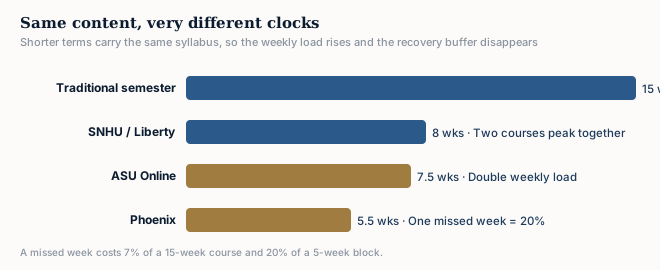
Term structures at the schools we see most
| Institution | Term length | Defining characteristic |
|---|---|---|
| SNHU | 8 weeks | Milestone chains feeding a final project; two concurrent courses peak together in weeks 5 and 7. |
| ASU Online | 7.5 weeks | Roughly double the weekly load of a standard semester. Withdrawal deadline arrives fast. |
| University of Phoenix | 5–6 weeks | One course at a time. A missed week is a fifth of the grade with no slack behind it. |
| Capella | 12-week FlexPath sessions or 10-week quarters | Two entirely different models. FlexPath is scoring-guide driven with no imposed deadlines. |
| WGU | 6-month terms | Flat tuition, unlimited courses. Every extra course cleared inside a term is free. |
| Liberty | 8 weeks | Turabian in some programmes, APA in others — the citation split catches people out. |
| GCU | 7–8 weeks online | Halo, GCU's own platform rather than Canvas or Blackboard. Nothing learned on another LMS transfers cleanly. |
| Walden | Graduate-weighted | Canvas classroom, SafeAssign on submissions, and residencies or field placements sitting outside the course. |
| Strayer | 11-week quarters | 4.5-credit courses with one repeating deadline: Sunday at midnight, every week of the quarter. |
| Purdue Global | 10-week terms | One or two courses per term, so a single bad course is half the term. ExcelTrack runs self-paced alongside. |
What is the same everywhere
Whatever the institution, a few mechanics recur and account for most avoidable losses.
The running-total gradebook. Canvas, Blackboard and Brightspace all default to showing a grade calculated only from work already marked. Unsubmitted assignments are not counted as zeros — they are not counted at all. Students routinely believe they are twenty points higher than they are.
Discussion boards. Typically 15–25% of the grade, almost always requiring an initial post and two substantive replies on staggered days. The replies are the half most often skipped and roughly two-thirds of the available marks.
Availability windows versus due dates. A passed due date usually still accepts late work with a penalty. A passed availability close accepts nothing at all, ever. These look identical on a course calendar.
Time zones. Deadlines are set in the institution's zone, not yours. An 11:59pm Eastern cutoff has already gone at 9pm Pacific.
Institutional policy is the part that genuinely varies
Academic integrity policy differs substantially between institutions, and it is the variable that matters most before engaging any service. Handbooks differ on what counts as unauthorised assistance, whether practice work is treated differently from graded assessment, what happens on a first finding, and whether an appeal route exists.
Our position does not vary by school: routine coursework where your institution permits it, and never anything invigilated. Proctored exams, ATI and HESI predictors, competency assessments and anything verified against your identity are yours. We refuse those every week. Our academic integrity page sets out the full position.
If your university is not listed
The pages above cover the institutions we are asked about most, not the only ones we work with. We support students at community colleges, state universities, private institutions and online-first programmes across all fifty states.
What we need is not the university's name but the mechanics: what platform the course runs on, how long the term is, how the grade is weighted, and which components are invigilated. Those four answers tell us more than the institution does. Send a syllabus and we can tell you what is realistic before you commit to anything.
“Pay someone to do my class” — the school changes the job
Two students with the same course title at different institutions are doing different work. Term length, platform, citation expectation and how a missed week is penalised all vary by school, and those four decide the plan more than the subject does.
What actually changes between institutions — and what does not
Students often assume that help with a Capella course is a fundamentally different product from help with an ASU course. Mostly it is not. What changes is scheduling and format; what stays constant is the subject work.
Changes by institution: term length and therefore weekly load; the rubric style and how strictly it is applied; the citation convention, which can differ between programmes inside the same university; whether assessment is exam-weighted or submission-weighted; how progression rules treat a failed course; and the withdrawal calendar.
Does not change: the mathematics in a statistics course; the pathophysiology behind a care plan; the accounting cycle; the way a rubric rewards analysis over summary. A specialist in the subject is a specialist regardless of whose logo is on the LMS.
This is why we match by subject first and institution second. A nursing specialist who has written a hundred care plans is the right person whether the programme is at Chamberlain, WGU or a state university — what the institution determines is the template, the deadline rhythm and the rubric language.
Progression rules are the underrated risk
The rule most likely to cause serious damage is not academic difficulty but progression policy, and it varies enormously.
Nursing programmes are the strictest. Many permit only one course failure across an entire degree, require a minimum grade of C+ or B− in every nursing course where a C would pass elsewhere, and run courses in a fixed sequence offered once a year — so a single failure can cost twelve months rather than one term. Readmission after dismissal is often competitive rather than automatic.
Competency-based institutions attach different consequences. At WGU, failing to complete a minimum number of competency units in a six-month term affects standing and can affect financial aid eligibility.
Accelerated programmes compress the decision points. In a five-week block the withdrawal deadline can arrive before the second graded assessment has been returned, which means the information you would want in order to decide may not exist when the deadline passes.
If you are near a threshold, the number matters more than the effort. A 74% in a course requiring 75% is not a near miss — at many programmes it is a year. We would rather work out with you what is mathematically still available than take on work that cannot reach the mark you need.
Institution and platform are separate questions
People often describe their course by the university when the thing causing the difficulty is the platform, or the reverse. They are independent variables and both matter.
A single institution commonly runs several platforms across its programmes — Canvas for one college, Blackboard for another, with publisher systems like MyLab, ALEKS or Connect layered on top for specific courses. Two students at the same university can therefore have almost nothing in common in how their coursework actually behaves.
The publisher layer is usually where marks leak. A student may be entirely comfortable with Canvas and still lose a fifth of their grade inside MyLab because they did not know attempts were limited to three per question, or inside ALEKS because a knowledge check removed twenty topics they thought were banked. Those are platform behaviours, not institutional ones, and they follow you between universities.
When you contact us, the two most useful facts are the platform combination and the term length. The university's name is helpful context; those two are what shape the plan.
Transfer credit — the courses you may not need to take
Worth checking before paying anyone to help with a course you might not have to complete.
Online-first institutions generally accept transfer credit fairly generously at undergraduate level, and many also award credit for professional certifications, military training and prior learning assessment. Students routinely enrol in courses that existing credit would have covered, because nobody prompted them to ask.
This matters most at subscription-priced institutions. At WGU, where a flat fee covers a six-month term, a course removed from your requirements is not just a cost saving — it releases capacity inside a fixed window that can be spent completing something else. The same logic applies to Capella FlexPath sessions.
Ask your enrolment counsellor or advisor for a written degree audit showing exactly which requirements remain, and ask specifically whether any certification you hold maps to a course. It is free, it takes one email, and it occasionally removes the problem entirely.
Who contacts us, by institution type
The pattern differs enough by institution type to be worth setting out, because it shapes what help actually looks like.
Online-first universities — SNHU, ASU Online, Phoenix, Capella, WGU, Liberty. Overwhelmingly working adults, often with families, on compressed terms designed on the assumption that something in their week will give. The problem is almost never capability; it is that a seven-week course expects the hours of a full-time student from someone working fifty.
State universities and community colleges — more traditional semesters, more general-education requirements taken outside a student's field. The typical request is a single required course in something unrelated to the degree, with nothing downstream depending on it.
Nursing programmes specifically — the highest-pressure group we work with, at any institution. Clinical days plus theory plus care plans plus standardised testing, with progression rules that turn one failure into a lost year. Also the group where we refuse the most work, because so much of their assessment is invigilated or licensure-linked.
Graduate and doctoral students — MBA, MSN, DNP, EdD. Usually know the material better than the coursework requires and have no hours in which to write it up. Capstones and dissertations here have external dependencies — ethics approval, data collection, supervisor turnaround — that cannot be compressed regardless of effort.
Whatever the category, the useful opening information is the same: the syllabus with its grading breakdown, the term length, and which assessments are proctored. From those three we can tell you what is realistic before you spend anything.
What we will not claim about any university
Every institution page on this site carries the same disclaimer, and it is worth stating here as well. We are an independent service. We are not affiliated with, endorsed by, partnered with or connected to any university named on this site. Where we describe how a programme works, that description comes from working with students enrolled in it, not from any relationship with the institution.
We mention this because the opposite claim is common in this industry. Services describe themselves as "partnered with" or "approved for" named universities, and it is essentially never true. No accredited institution partners with a coursework service.
Nor will we tell you that your particular university does not check, or that its policy is lenient, or that students there routinely do this without consequence. We do not know that about your institution and neither does anyone else selling you something. Your handbook is the authority.