
What actually happens if you're caught using an online class service
This is the question people ask us last, if they ask it at all, and it is the one that should come first. Here is how an integrity case generally runs, what sanctions look like at graduate level, and why the licensure question deserves an answer of its own.
Search this question and you find two kinds of page: the ones that do not mention it, and the ones that answer with a shrug — thousands of students do this, you will be fine. Neither is any use to a working adult halfway through a master's an employer is paying for. What you need is not reassurance but a realistic picture of how the process works, how far it can go, and which parts of it nobody writing a web page can answer for you, including us.
The short answer
It depends on your institution, and that is a real answer rather than a dodge. There is no national rule and no central register. There is, at almost every university, a published academic-integrity policy setting out a process and a range of sanctions — and its consequences land on you, not on whoever did the work. Most people who search pay someone to do my class have never opened the integrity section of their own handbook, which is the one document that actually answers the question they are asking.
Our own academic-integrity disclaimer says the same: submitting work completed by someone else will usually breach a university's policy; consequences vary by institution and can include a failing grade, a mark on your record, suspension or dismissal; and we cannot tell you what your institution's policy says or how it would treat your situation. That is yours to read and yours to weigh. The companion to this post, whether this kind of help is safe at all, covers the other half of the risk: the service itself. This is the institutional half.
How a case usually starts
Most cases begin with a person, not a verdict. An instructor reads something that does not sit with the rest of a student's work — a submission in a different register, a discussion post unlike the twelve before it — and raises a concern. Software may prompt a second look, but at institutions that publish their procedures what follows is a human review rather than an automatic finding. What a university can and cannot actually see is a larger subject than one paragraph, and it deserves its own post rather than a bad summary here.
How the process generally runs
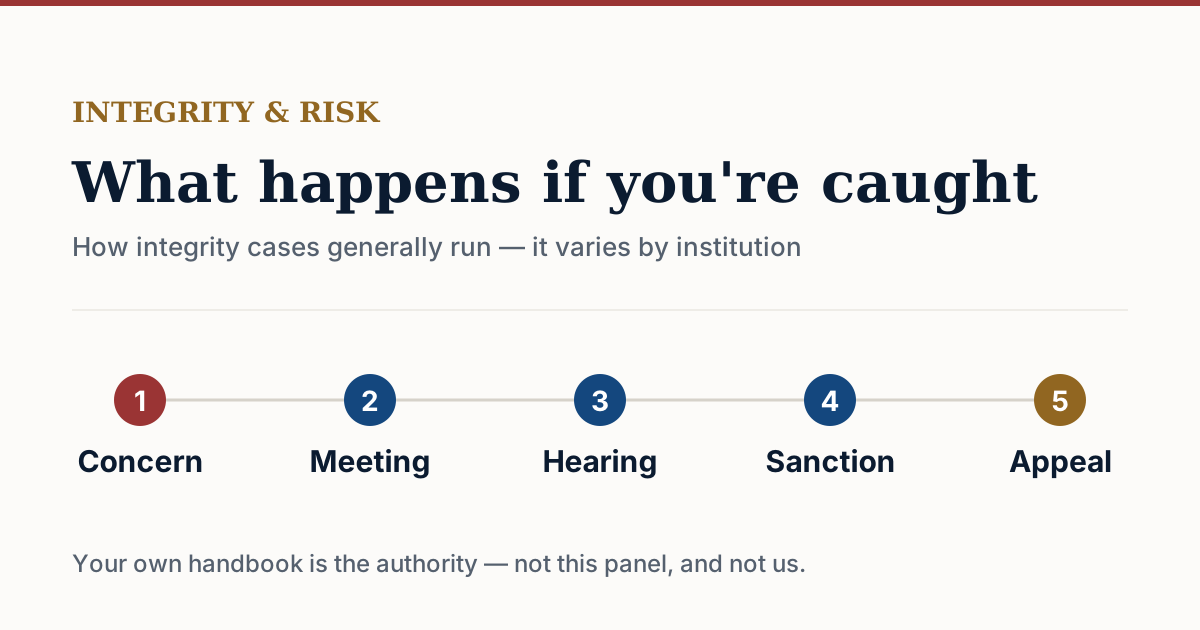
Written procedures differ in their details, but their shape is unusually consistent. A concern is raised. The student is invited to a meeting, usually with the instructor first — and at many institutions a case can be resolved at that stage, particularly a first one. If it is not resolved there, it is referred on to an integrity officer, a committee or a panel. A finding is made and a sanction attached to it. There is then, in most published procedures, a route of appeal, generally on narrow grounds such as procedural error or new evidence rather than a full rehearing.
Several features of that process matter more than students expect. Many institutions give the student the right to see the evidence before the meeting. Many allow an advisor or support person to attend, sometimes anyone the student chooses. Many decide on the balance of probabilities, a more-likely-than-not standard, rather than anything resembling proof beyond reasonable doubt. And many treat a first finding quite differently from a second.
Every one of those sentences says many, and the word is carrying real weight: each is accurate for a large share of published procedures and wrong for some. The only procedure that governs you is the one in your own handbook, and reading it takes about twenty minutes. If the language is hard to follow, most universities have an ombuds office or student advocate whose job is to explain the process without taking a side, and that conversation is free. Where a licence is in play, some people take advice from a lawyer who works on education cases before the first meeting rather than after the finding.
What sanctions look like at graduate level
The range, mildest to most serious, runs roughly: a zero on the piece of work; a failing grade for the whole course; a notation on the transcript recording an integrity finding; suspension for a term or longer; dismissal from the programme; and, rarely and only at some institutions, revocation of a degree already conferred.
Graduate students often sit further up that range than they expect, for structural reasons rather than severity for its own sake. Progression rules are tighter: many programmes require a B or better in core courses and open an academic review after a single failed one, so a sanction an undergraduate would absorb collides with a progression standard instead. Cohorts are unforgiving — a course that runs only in the spring is not one you simply retake in the autumn, and a term's suspension can cost a year. And a repeat finding is treated far more harshly than a first almost everywhere.
There is a financial edge to it as well. If an employer is funding your degree, a failing grade or a withdrawal may trigger a repayment clause in your tuition reimbursement agreement — a separate contract from anything your university decides, and one most people sign once and never reread. Find your copy and read the repayment trigger; it is usually on the first page.
The licensure question
This is the part people are really asking about, and almost nobody writes it. In nursing, social work, teaching and accounting, the degree is a step toward a credential a board controls — and that board is a separate authority from your university.
How it generally works: licence and certification applications in these fields commonly include character, fitness or disciplinary questions, and some ask directly whether an applicant has been subject to academic discipline. Some boards also ask the programme itself to certify a graduate's standing or good character rather than relying on the applicant's answer alone. Whether your board asks, how far back the question reaches, and what it does with a disclosed answer varies by state and by profession — and a disclosed finding is not automatically a refusal, any more than it is automatically irrelevant.
So the honest instruction is short, and it is not something we can do for you. Open your own licensing board's website and read the actual application questions before you decide anything — they are published, usually as the application PDF itself, and they are specific where every article about them is vague. Then read your programme's handbook on whether and how it reports findings to a board. We will not tell you a finding would end a career, and we will not tell you it would pass unnoticed. Both are guesses about an authority we have no standing with.
What we will and won't tell you
We cannot assess your institutional risk and will not pretend to. People write asking whether their university will notice; the truthful reply is that we do not know their institution, their instructor or their course, and that anyone answering it confidently is selling something. We do not claim that work is impossible to spot, and we do not claim to beat any integrity system. When someone asks us to take my online class for me, what we can describe is the work, the people doing it and the price — not what a university would decide.
What we do put in writing is set out on our grade commitment: a target band agreed before work begins, on courses where it is realistic, with the exclusions stated. It covers the work and the grade terms on that page. It cannot cover what your institution decides, and we would be misleading you if we implied otherwise. Where an exam is monitored, our position is a spectrum rather than a yes or a no, set out on our proctored exam page and assessed free before anyone pays.
If the licensure stakes are not acceptable to you — and for some readers they should not be — the honest alternatives are worth more than our sales page. Ask about an Incomplete, which many programmes grant for exactly these circumstances. Consider a withdrawal: it costs money and time but carries no finding. Or use tutoring rather than done-for-you work, where someone walks you through it and you submit it yourself. This may not be right for you, and saying so is the only thing that makes the rest of this page believable. People who ask us to take my class for me and leave having chosen an Incomplete are, as far as we are concerned, a good outcome.
Before you decide — five things to check
None of this takes an afternoon, and all of it is free. One: your handbook's academic-integrity section, including its sanction table and appeal route. Two: your programme's progression rule — the minimum grade in core courses, and what follows a single failure. Three: your licensing board's actual application questions, from the board's own site, if your field has one. Four: your tuition reimbursement agreement, if an employer is paying, and specifically its repayment trigger. Five: whether an Incomplete or a withdrawal would actually solve your problem, which is more often a time problem than an ability one.
Read those five and you will know more about your exposure than any article can tell you, this one included. If you have, and still intend to pay someone to take my class, you will at least be deciding with the real numbers in front of you.
This article is educational content and is not legal, licensure or academic advice. Processes, sanctions and board requirements vary by institution and jurisdiction. Students are responsible for reading and following their own institution's academic-integrity policy.