
Take my nursing homework — including the math that has to be exact
Nursing homework carries a weight ordinary homework doesn't: a dosage-calculation error isn't a lost point, it's a rehearsal for a real mistake. We match your nursing homework to clinically-trained experts who get the math right and show the working.
Nursing homework is deceptively demanding. On the surface it's the usual mix of readings, quizzes and worksheets; underneath, a good deal of it is safety-critical practice for the clinical setting. Dosage calculations are the clearest example — the exact skill you'll use to avoid harming a patient, drilled through homework that gives no credit for "close." Add adaptive quizzing systems that re-test what you claim to know, drug cards that demand real pharmacological detail, and care-plan worksheets that expect the correct NANDA-I structure, and nursing homework becomes a steady, high-stakes stream that's easy to fall behind on during a term full of twelve-hour clinical shifts. That's exactly the pressure this service is built for.
Below you'll find the kinds of nursing homework we handle, why the calculations get special care, the platforms your homework lives in, and how it fits with the rest of your nursing coursework. For the full picture — care plans, ATI/HESI, pathophysiology — see the main nursing class page. The message is generally sent at the end of a shift and reads take my nursing homework for me, I cannot do this tonight.
Why nursing homework can't be sloppy
A dosage error in homework is practice for a dosage error at the bedside, which is why programs grade it strictly and why we treat it with the same seriousness — exact answers, with the dimensional-analysis working shown.
The nursing homework we handle
Nursing homework spans the calculative and the conceptual, and we cover both.
Dosage and medication calculations
Drug dosage, IV flow rates, unit conversions, weight-based dosing and titration — the medication math nursing programs drill relentlessly. We handle it with careful dimensional analysis, showing each step, because in this area the method is the safeguard and the working is often part of the grade.
Drug cards and pharmacology worksheets
The recurring assignment to profile a medication — mechanism, indications, adverse effects, nursing considerations and patient teaching. These reward real pharmacological understanding, and our nursing experts complete them with genuine clinical detail rather than a copied monograph.
Care-plan worksheets and case studies
Shorter care-plan exercises and case-study homework that apply the NANDA-I / NOC / NIC framework to a scenario. We build them to your program's required format, consistent with the fuller care-plan work on our nursing page.
Adaptive quizzing
Lippincott PrepU, ATI practice, and similar adaptive systems that adjust difficulty and re-test mastery. As with all adaptive platforms, we work these with steady, accurate progress that reflects real understanding rather than shortcuts the system is built to catch.
Platforms and how we work them
Nursing homework runs on both nursing-specific tools and the general LMS.
| Tool | Used for | Note |
|---|---|---|
| Lippincott PrepU | Adaptive quizzing | Difficulty adapts; consistency matters |
| ATI | Practice questions, tutorials | Coursework and practice supported |
| Lippincott DocuCare | Simulated charting | Documentation exercises |
| Canvas / Blackboard | Worksheets, quizzes, dropboxes | Uploaded and auto-graded homework |
How it fits your nursing coursework
Homework is rarely the whole problem — it's usually one strand of a nursing term that's become unmanageable, alongside care plans, discussions and exams. Many students hand us the homework specifically to free up time for clinical, then find it easier to add the rest. Whether you want just the dosage sets handled or the entire course managed, we scope it to what's actually drowning you. See nursing class help and whole-course help for the broader options.
The honesty carries over
The same policy applies to any monitored nursing homework or exams: we assess it and tell you honestly before you pay. Nursing's proximity to licensure means we're especially careful here.
Dosage calculation — the three methods, and why the method matters
Dosage calculation is the assignment type nursing students most often hand over, and the one where a correct answer written the wrong way still loses marks. Most programmes teach one of three approaches and expect to see it in your working.
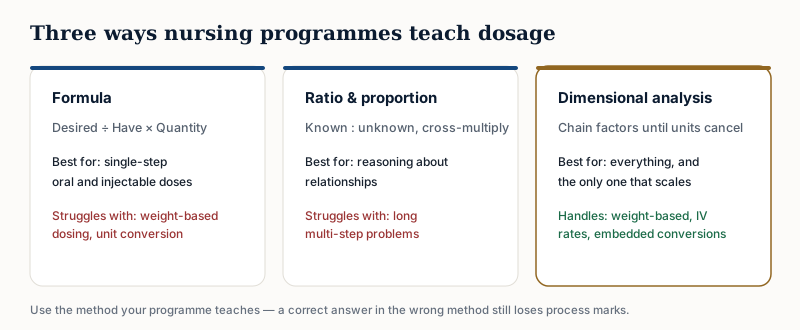
The formula method
The classic desired-over-have arrangement: (desired dose ÷ dose on hand) × quantity. Quick for straightforward single-step problems and the method most textbooks lead with. It becomes unwieldy the moment weight-based dosing or unit conversion enters, because each additional step needs its own separate calculation.
Ratio and proportion
Setting the known relationship against the unknown and cross-multiplying. Conceptually clear and popular in programmes that want students to reason about relationships rather than plug into a formula. Slower on multi-step problems.
Dimensional analysis
Chaining conversion factors so units cancel until only the required unit remains. This is the method that scales — weight-based paediatric doses, IV drip rates in mL/hr from an order in mcg/kg/min, unit conversions embedded mid-problem. Many programmes now teach it exclusively for exactly that reason, and it has the additional virtue that the working itself demonstrates whether you understood the problem.
We write the working in whichever method your programme uses. That is not a cosmetic preference. A dimensional-analysis programme grading a formula-method answer will mark down the process even when the number is right, because the process is what the assignment is assessing.
A worked example, dimensional analysis
Order: heparin 18 units/kg/hr for a patient weighing 176 lb. Available: 25,000 units in 250 mL. Required: infusion rate in mL/hr.
Chain the factors so unwanted units cancel — pounds to kilograms, kilograms to units per hour, units to millilitres:
176 lb × (1 kg / 2.2 lb) × (18 units / kg/hr) × (250 mL / 25,000 units) = 14.4 mL/hr
Two things about that answer matter as much as the arithmetic. It carries the correct unit, and it is rounded the way infusion pumps and most programmes expect — to one decimal place for a rate like this. A numerically correct answer presented as "14" or as "14.4 units" would lose marks in most rubrics.
Where dosage answers actually lose marks
- Rounding at the wrong stage. Round once, at the end. Rounding intermediate steps compounds error and produces a figure that does not match the key.
- Rounding to the wrong precision. Tablets to the nearest half or whole, mL commonly to one decimal, paediatric doses often to two. It varies by programme and by drug.
- Missing or wrong units. A bare number is frequently marked wrong on principle, and rightly so — an unlabelled dose is a clinical hazard.
- No working shown. Many rubrics award most of the credit for the setup, not the answer.
- Not sanity-checking the result. An answer of 340 mL/hr for a routine antibiotic should stop you. Programmes increasingly award marks for recognising an implausible result.
“Pay someone to do my nursing homework” — what that covers here
Dosage calculations, case questions, pathophysiology sets, care-plan drafts and the reading responses attached to them. Everything on that list is written coursework. Nothing on it is clinical practice, and the distinction is not a formality — it is the difference between academic support and something neither of us should be doing.
Drug cards, and what a good one actually contains
Drug cards look like busywork and are graded as if they were not. Most rubrics want the same fields, and the ones students skimp on are the ones that carry the marks.
| Field | What is actually expected |
|---|---|
| Generic and trade name | Both, generic first — programmes are strict about this order |
| Drug class | Pharmacological and therapeutic class, which are not the same thing |
| Mechanism of action | How it works at receptor or cellular level, not what it treats |
| Indications | Including the specific indication for your assigned patient |
| Dose range and route | Usual adult range, and whether your patient's dose sits inside it |
| Contraindications | Absolute and relative |
| Adverse effects | Common ones, and separately the life-threatening ones |
| Nursing implications | What you assess before, during and after administration |
| Patient teaching | What the patient needs to be told, in language they would understand |
| Labs to monitor | With the actual therapeutic ranges, not just the test names |
The two fields that separate a Proficient card from a Distinguished one are nursing implications and the patient-specific link. Anyone can copy a mechanism of action from a drug guide. Explaining that you will check apical pulse for a full minute before digoxin and hold for a rate below 60, and connecting it to this patient's potassium result, is nursing judgement — and that is what the rubric is looking for.
Care-plan worksheets and concept maps
Care-plan homework is where nursing writing is most obviously different from other academic writing, and where a generalist writer is most obviously out of their depth.
The NANDA-I structure
Diagnoses follow a defined format — problem, aetiology and evidence, commonly written as problem as evidenced by data related to cause. The wording is not free. NANDA-I diagnoses are a standardised taxonomy, and "patient is in pain" is not one of them. Programmes expect the approved label with correct related factors and defining characteristics drawn from your patient's actual assessment data.
NOC outcomes and NIC interventions
Outcomes must be measurable and time-bound: not "patient will feel better" but a specific, observable, dated target. Interventions must be nursing interventions with a stated rationale, and the rationale is usually where marks are won or lost. "Reposition every two hours" earns little on its own; "reposition every two hours to relieve capillary pressure over bony prominences and reduce shear injury risk" earns the criterion.
Prioritisation
Most rubrics require diagnoses in priority order, usually justified by an explicit framework — Maslow, ABC, or acute-before-chronic. Listing three plausible diagnoses in arbitrary order loses the prioritisation criterion even when each diagnosis is individually sound.
Concept maps
Some programmes prefer a concept map to a linear care plan, requiring you to show relationships between the medical diagnosis, pathophysiology, medications, labs and nursing diagnoses. The content overlaps with a care plan; the assessment is about whether you can show how the pieces connect. We build these as genuine maps rather than lists arranged in boxes.
ATI, PrepU and adaptive quizzing
Nursing programmes lean heavily on adaptive quizzing platforms, and the mechanics differ enough to matter.
- ATI assignments include practice assessments, tutorials and remediation. Remediation is often the graded part — you are required to demonstrate you have reviewed what you got wrong, sometimes as written work with a minimum length. Students frequently complete the quiz and skip the remediation, which is where the marks were.
- Lippincott PrepU adapts difficulty to your performance and assigns a mastery level per topic. Like other adaptive systems, mastery can regress. Consistent correct work settles it; guessing makes it oscillate.
- Evolve and HESI resources appear in programmes using Elsevier materials, with case studies and practice assessments attached to coursework.
On standardised exams themselves — ATI proctored assessments, HESI exit exams — our position is deliberately conservative. Those are frequently monitored, they are often gatekeeping for progression, and they exist to establish whether you are safe to practise. We support the coursework, the practice work and the remediation writing around them. We assess the monitored assessments themselves honestly before you pay, and where the answer is no, we say no. See the proctored exam page.
Homework by course, and what each one demands
| Course | What the homework looks like |
|---|---|
| Pharmacology | Drug cards, dosage calculation, mechanism questions, case-based application |
| Pathophysiology | Disease-process questions, concept maps linking mechanism to manifestation |
| Medical-surgical | Care plans, case studies, prioritisation and delegation questions |
| Fundamentals | Skills documentation, basic care planning, dosage practice |
| Maternal-newborn and paediatrics | Weight-based dosing, growth and development, family-centred care planning |
| Mental health | Therapeutic communication exercises, psychotropic drug cards, process recordings |
| Community and population health | Assessment projects, epidemiology, teaching plans |
| Nursing research and EBP | Article critiques, PICO questions, evidence tables |
Weight-based paediatric dosing deserves a note. It is where dosage calculation stops being arithmetic and starts being clinically consequential, because the safe range is narrow and the consequence of an error is not a lost mark. Programmes grade it accordingly, and safe-dose-range verification is frequently a rubric criterion in its own right — you are expected to state whether the ordered dose is safe, not merely to calculate it.
How we handle nursing homework
Nursing homework goes to people with clinical training, not to generalist writers. That is not a marketing line — it is the difference between a care plan that uses the NANDA-I taxonomy correctly and one that reads as invented, and any nursing instructor spots the difference in a paragraph.
For dosage work we show the full setup in your programme's method, carry units through every step, round once at the end to the precision your programme specifies, and sanity-check the result against a plausible clinical range. For drug cards we complete every field the rubric asks for and connect the pharmacology to your specific assigned patient. For care plans we use the approved taxonomy, write measurable time-bound outcomes, give each intervention a rationale, and prioritise with a stated framework.
If you would rather hand over the whole course than individual assignments, that is our nursing class page. If it is the exams specifically, see nursing exam help. And if what you actually need is a straight answer about whether a monitored ATI assessment is something we will touch, the answer is on the proctored exam page and it is more often no than the rest of this industry will admit.
Turnaround on single assignments
Most nursing homework is small and urgent rather than large and distant. A drug card due tomorrow, a dosage worksheet due tonight, a care plan for a patient you were assigned this morning. We quote these individually and the quote is fixed before anything starts, so a two-hour job costs what a two-hour job costs.
What we will not do is accept a deadline we cannot meet properly. Dosage work done in a hurry is dosage work with an arithmetic slip in it, and a care plan written without your actual assessment data is a generic template that reads as one. If a deadline is genuinely too tight to do properly, we will say so and tell you what is achievable instead.
If you have decided to pay someone to take my nursing homework
Say which parts are calculation and which are written. Dosage work and care-plan writing go to different specialists here, and sending both under one description is the fastest way to get the wrong person on it.
Nursing homework FAQ
Can you do dosage calculation homework?
Yes — with the dimensional-analysis working shown. Accuracy is non-negotiable in dosage math, and the method is often graded, so we treat both with care.
Do you work in PrepU and ATI?
Yes — adaptive quizzing in PrepU and practice work in ATI are handled with steady, accurate progress that reflects genuine mastery.
Can you keep up with weekly nursing homework?
Yes — ongoing homework management is common, and popular during heavy clinical rotations. We handle each set on schedule so nothing piles up.
What does nursing homework help cost?
It's quoted by volume and type, as one fixed price. See pricing.
Can you take my online nursing homework for me during a placement block?
Yes, and that is when most nursing students ask. The homework is what slips when placement hours dominate the week, and keeping it moving is usually what protects the grade.
Related pages
Free up your clinical hours
Send the homework and platform. You'll get an honest answer within hours, and a price once we understand the course.