
How much does it cost to pay someone to take my online class?
Nobody publishes a straight answer to this, and the reason is not mysterious: the honest number depends on things a website cannot know until it has seen your course. Here is what actually drives it, and what our own floor is.
Search this question and you will find two kinds of page. The first quotes a suspiciously precise figure — $299 a class, say — with no mention of length, subject or what is included. The second refuses to say anything at all until you hand over your details. Both are avoiding the same awkward fact, which is that the price of taking a course off someone's hands is genuinely variable, and anyone quoting before they have seen the syllabus is either guessing or planning to revise the number later.
This post sets out the five things that actually move the price, what our own figures are, and how to read a quote from anybody — including us.
Our numbers, stated plainly
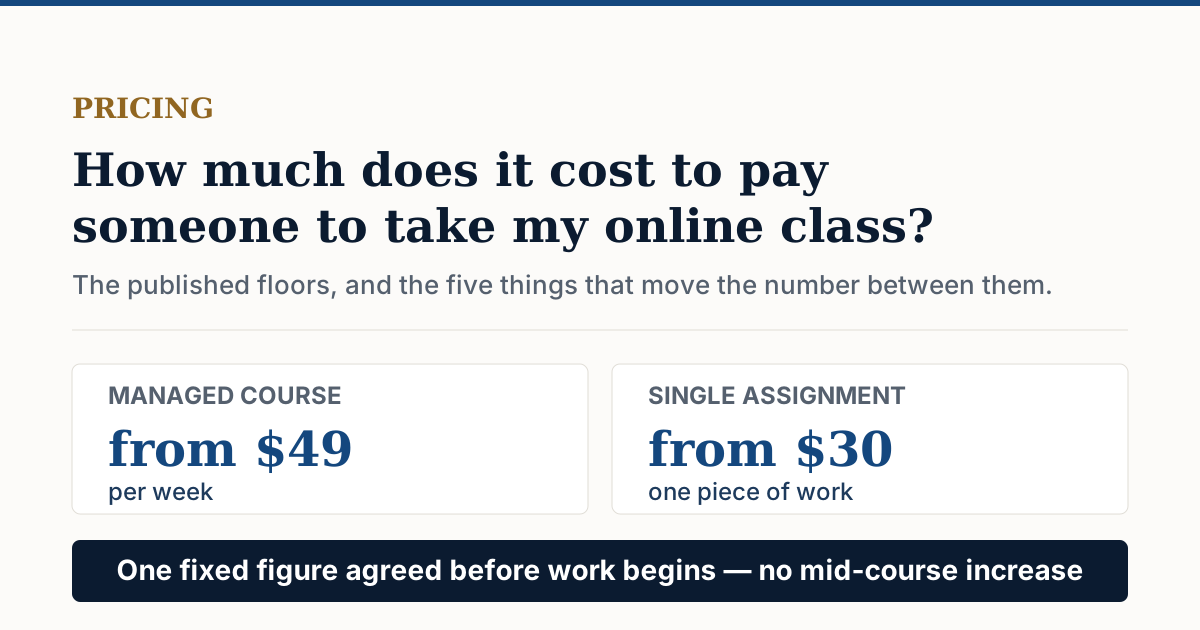
Whole-course support starts from $49 per week. A single assignment starts from $30. You get one fixed all-in figure before any work begins, and it does not move mid-course. The assessment that produces that figure is free, and a real person replies within about two hours during working hours.
Those are floors, not averages. A twelve-week general-education course with weekly discussions and two papers sits near the bottom of the range. A graduate statistics course with proctored assessments and a capstone component does not. The pricing page sets out the structure in more detail.
What actually drives the number
1. How long the course runs
This is the biggest single factor and the one students underestimate. Weekly support priced per week means a seven-week compressed term and a sixteen-week semester are different totals for the same nominal course. It also cuts the other way: short terms concentrate the work, so the weekly rate buys more activity per week.
2. What the assessment mix looks like
A course built from weekly discussion posts and two essays is steady, predictable work. A course built from proctored midterms, a group project and a lab component is not — parts of it may not be work we can take at all. The mix decides both the price and whether a quote is even possible: where a component sits outside what we will do, we say so before quoting rather than after.
3. How far behind you already are
The message that reaches us at this stage is rarely more elaborate than take my class for me, and the arithmetic behind it is unforgiving. Catching up costs more than keeping up, for a straightforward reason: the same work has to be done in less time, by whoever is available rather than by the best-matched specialist, with no room for a checking pass. A course handed over in week two is cheaper per week than the same course rescued in week nine. If you are weighing this up, contacting someone early is the cheapest decision available to you, even if you decide against it.
4. Whether exams are involved
Coursework and examinations are priced differently because they carry different risk and different constraints. And before price enters it at all, there is an eligibility question: how an exam is monitored determines whether we will take it. Time-limited tests with no observation are routine; lockdown browsers are assessed case by case; live invigilation with a room scan is declined. Our proctored exam page sets out the whole spectrum. That assessment is free and it comes first.
5. The subject, and who has to do it
Not all subjects cost the same, because not all specialists are equally available. A first-year composition course draws on a much wider pool than a graduate econometrics course or an advanced nursing theory sequence. That is a supply fact rather than a judgement about difficulty, and it shows up in the quote.
What you are buying when you pay someone to do my class
Worth separating from the price, because the two get conflated. You are buying a named specialist’s time against a specific brief, on a schedule, with a stated limit on what they will not touch. You are not buying a grade, and any figure attached to a grade promise is priced against a risk the seller has no way to carry. That is the distinction that makes one quote comparable with another at all.
Why nobody publishes a single number
Because the honest version of the answer is a range, and a range looks weaker in an advertisement than a figure does. A service that leads with "$299 per class" has either defined "class" so narrowly that most real courses fall outside it, or has built in the expectation of revising the price once the work is under way.
The test worth applying is not whether a price is published, but whether it is fixed when it is given. A quote that arrives after someone has read your syllabus, and does not move afterwards, is worth more than a headline number that does.
How to read any quote, including ours
Four questions. They take one message to ask and they separate serious operations from the rest.
- What is included? Discussions, quizzes and the final assessment are frequently excluded from a low headline price. A cheaper figure for less work is not cheaper.
- Can it change? Ask directly whether the figure can move once work starts, and what would cause it to.
- Who is doing it? A price with no named specialist behind it is a price for an unknown.
- What would you decline? The most revealing question of the four. A service that declines nothing is assessing nothing.
Can someone take my online class for me for a fixed fee?
Yes, and the fixed part is what to check. Ours is one all-in figure agreed before work starts, covering the components you hand over for the term you hand them over for. What makes a fee genuinely fixed is that nobody has left themselves room to re-price it once the work is under way.
When paying is the wrong answer
Sometimes the arithmetic says no, and a service worth using will tell you. If the remaining assessments cannot mathematically reach a pass, if submission points have already closed, or if withdrawing protects your GPA better than a rescued grade would, then the right advice costs us the work. Our calculators will answer the first of those in about ten minutes, before you speak to anyone.
We would rather lose an engagement than take payment for an outcome we do not believe in, and the honest answer is free either way.
The short version
From $49 a week for a managed course, from $30 for a single assignment, one fixed figure before work begins, and a free assessment first that sometimes ends in us saying no. Everything above is what moves the number between those floors and whatever your course actually costs.
If you want a real figure for a real course, send the syllabus and where you are in the term. You will get a person's reply, usually within about two hours, and one price that does not change afterwards.
Want the number for your course?
Send the course, the term length and what is outstanding. The assessment is free, the reply comes from a person within about two hours during working hours, and the price you are given is the price you pay. Ask for a price or read the pricing page first.